
Neural Information
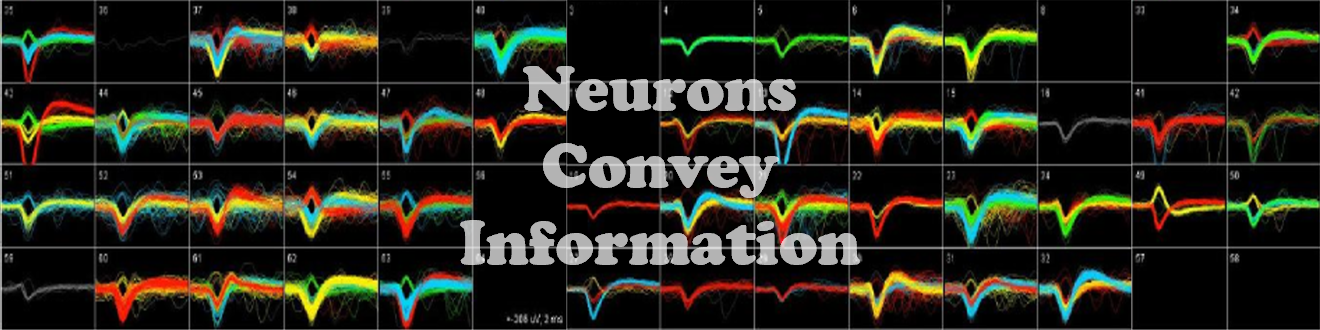
Our lab explores neural information: the foundational principles by which the nervous system encodes, transmits, and transforms data to navigate the world. Neurons collect information from the outside world, pass that information amongst themselves, store it for milliseconds to decades, and process it to make decisions that drive behavioral responses. Just like the digital data running through computers, this neural information can be quantified (e.g., in bits) allowing us to mathematically trace how signals are shared and reshaped across entire neural hierarchies, from sensory receptors in the periphery up to cogitating networks in the prefrontal cortex. Understanding healthy information routing is an important goal, but we are equally driven by how these pathways degrade; we investigate how information transmission breaks down in disordered states, and how therapeutic interventions can restore functional data flow. Ultimately, we seek to bridge biological processing with engineering to devise novel, bio-inspired information-frameworks for future iterations of artificially intelligent systems.
Our lab sits at the intersection of basic neuroscience and neuroengineering. Through experimental, clinical, and computational work, we aim to decode brain signals, and to interpret the differences in neural information processing between default and disordered conditions. We seek to leverage this understanding to develop devices and approaches to modulate neural activity to treat neurological disorders.

Biological Information
The nervous system encodes and transmits data using quantifiable metrics of information. We apply statistical frameworks to decode these neural signals, measuring how data is shared across circuits in bits to better understand healthy cognition and what happens in disordered disease states and in response to therapy therefor.
Computational Neuroscience
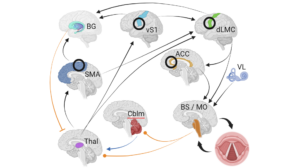
Mathematical modeling provides a vital bridge between experimental neurobiology and theoretical brain function. We build biophysically realistic computational models of neurons and networks to simulate pathological dynamics and test novel therapeutic interventions in a highly controlled digital environment.
Architecture of Neural Identity
As neural interfaces advance, the relationship between biological computation and human essence becomes increasingly complex. We explore the philosophical and functional boundaries of our field, investigating how modifying neural information processing interacts with neural semiotics to shape the architecture of our identity.