
Neural Network Processing
To complement our experimental recordings, we employ computational neuroscience to investigate how information is processed, transmitted, and consolidated across complex neuronal networks. By building detailed in silico models, we can simulate large-scale neural dynamics to uncover the fundamental principles governing both healthy cognition and motor dysfunction. Our computational efforts range from exploring how biophysical phenomena—such as stochastic resonance—optimize memory consolidation, to modeling the disrupted basal ganglia-thalamic circuits seen in Parkinson's disease. These circuit-level simulations allow us to systematically test how interventions like Deep Brain Stimulation (DBS) abolish pathological activity and restore high-fidelity information relay, bridging the gap between single-neuron biophysics and macroscopic brain function.
Neuronal Membrane Computation
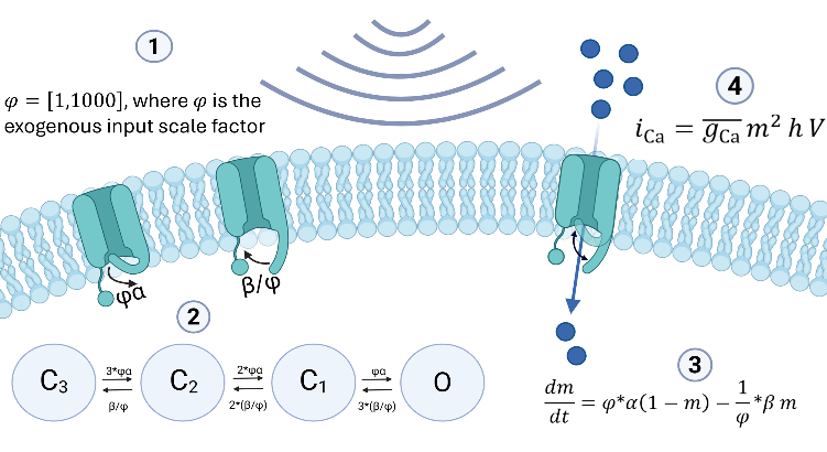
At the most fundamental level of neural computation, the biophysical properties of individual neuronal membranes dictate how information is generated and transmitted. Our research investigates how microscopic membrane phenomena—such as the stochastic opening and closing of ion channels and fluctuating synaptic background conductances—profoundly influence macroscopic neuronal behavior. Using a combination of computational modeling and dynamic clamp electrophysiology, we explore how channel noise and synaptic input statistics shape the variability, reproducibility, and oscillatory dynamics of neurons. By quantifying how these specific membrane properties govern features like spike phase-locking and perithreshold rhythms, we aim to uncover how single-cell biophysics translates into robust neural codes.