
Research Approaches
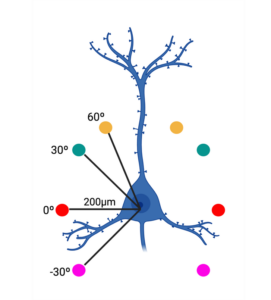 Our computational methodology is built on a multi-scale approach, allowing us to investigate neurophysics from the microscopic behavior of individual ion channels up to the macroscopic dynamics of interconnected brain regions. At the cellular scale, we develop conductance-based biophysical models to simulate ion channel stochasticity, membrane noise, and synaptic input statistics. To understand the physical interface between neural tissue and applied electrical therapies, we couple electric field models (including from finite element methods) with morphologically realistic representations of arborized neurons and serpentine axonal geometries. With these in silico efforts, we can test and optimizing electrode designs, electrical waveforms, and novel stimulation paradigms before they are evaluated in biological systems.
 Scaling up to the systems level, we utilize computational modeling to study how neural information is processed and transmitted across circuits. We construct small-scale, detailed network models to investigate dynamic phenomena such as stochastic resonance, signal fidelity, and t he rules governing memory consolidation. To capture macroscopic population dynamics, we implement multi-region, mean-field formalisms, including Wilson-Cowan architectures. These population models allow us to simulate the complex, interconnected loops of the basal ganglia, thalamus, and cortex, providing a mathematical sandbox in which to replicate the disrupted states of parkinsonism, epilepsy, dystonia, and other disorders. By bridging these computational scales, our simulation pipeline provides a rigorous, highly controllable methodology for decoding disease pathology and prototyping next-generation, closed-loop neuromodulation strategies.
 To isolate and interrogate the precise biophysical mechanisms of neural computation, we rely extensively on acute in vitro brain slice models. By preserving local microcircuitry—primarily within the hippocampus and entorhinal cortex—we can rigorously investigate how neurons, astrocytes, and microglia respond to exogenous stimulation in a highly controlled environment. Our optical methodologies center on multi-photon imaging of genetically encoded calcium indicators, allowing us to capture real-time, population-level calcium dynamics across diverse glial and neuronal networks. This high-resolution imaging is crucial for monitoring the localized, cellular-scale effects of novel neuromodulation paradigms, including temporal interference (TI) current fields and high-frequency electromagnetic fields (EMFs), without the confounding variables present in behaving animals.
 In parallel with optical imaging, we employ advanced input-output slice electrophysiology to probe single-cell and synaptic biophysics. Building on the Real Time eXperimental Interface (RTXI) which we helped develop, we utilize conductance/dynamic clamp protocols to introduce simulated ion channels and artificial synaptic conductances into living neurons in real time. By precisely manipulating exogenous currents and conductances, we can systematically map the input-output transformations of individual cells. This combination of targeted electrophysiology and network-scale calcium imaging provides an essential experimental bridge, allowing us to validate our computational models and empirically test the biophysical limits of our neuroengineering tools before transitioning to in vivo systems.
 As we pioneer next-generation, minimally invasive therapies like temporal interference (TI) stimulation, our in vivo methods also encompass targeted sensory and perceptual testing, such as quantifying how focal TI current fields alter visual perception and sensory processing. To ensure these novel technologies are safe, highly selective, and clinically viable, our experimental pipeline ultimately scales up to advanced translational pre-clinical models. By evaluating our hardware and stimulation paradigms in complex mammalian nervous systems—particularly the cortico-basal ganglia-thalamo-cortical loops—we can rigorously validate device safety and optimize spatiotemporal stimulation parameters before transitioning to human clinical trials.
 To ensure our neuroengineering innovations translate effectively to clinical practice, we rigorously analyze neural data acquired directly from human subjects, focusing primarily on populations with movement disorders and epilepsy. Our methodological approach relies on a multimodal synthesis of neural recordings and neuroimaging. We map cortical and subcortical connectivity by combining non-invasive tools, such as functional magnetic resonance imaging (fMRI) and functional near-infrared spectroscopy (fNIRS), with the high spatial and temporal resolution of direct intracranial recordings (e.g., sEEG/DBS/RNS). Integrating these diverse data streams, we work to identify robust physiological biomarkers that predict specific symptomatic states and network-wide dynamics.
 Beyond recording and imaging, our human subjects research heavily incorporates patient-specific computational methodologies and the analysis of chronic implant data. To optimize how applied electrical fields interact with highly variable neuroanatomy, we utilize advanced bioelectric field and multi-compartment modeling to build patient-specific electrode models that we can then tie to behavioral outcomes. We leverage data from clinical devices, extracting and parameterizing chronic intracranial recordings to evaluate periodic and aperiodic activity within and between brain regions as a function of disease progression and symptom severity in human patients. Anchoring our computational and engineering efforts in direct human physiology ensures that our next-generation neuromodulation strategies are personalized, precise, and primed for clinical efficacy.
 Advancing the frontier of neuromodulation requires not just applying existing technologies, but actively engineering the next generation of neuro-devices and neural-interfacing platforms. We develops tools across the spectrum, building both the physical hardware and the software control systems necessary for high-precision interventions. On the hardware front, for example, we design and prototype specialized, high-density architectures engineered for long-term implantation and highly focal neural targeting. To drive these devices and our broader experimental setups, we heavily utilize and develop applications for the Real-Time eXperiment Interface (RTXI), a robust platform enabling sub-millisecond-precision, for closed-loop feedback control from single-neuron dynamic clamp protocols in vitro to complex non-invasive neural interfacing in human subjects.
 Our tool development also encompasses computational pipelines required to translate raw clinical data into highly accurate, subject-specific, anatomical models. For example, localizing precise stimulation sites in human patients is notoriously difficult due to the large signal-void artifacts created by the metal implants during neuroimaging. To overcome this, we develop specialized image processing and registration pipelines to accurately map electrode contacts onto patient-specific anatomies despite visualization artifacts. Through the collective development of these neurotechnology tools, we help evolve the next generation of seamless, multi-scale neural interfaces.